ZIMBABWE’S CONSTITUTION UNDER SIEGE AS POWER TRUMPS PRINCIPLE
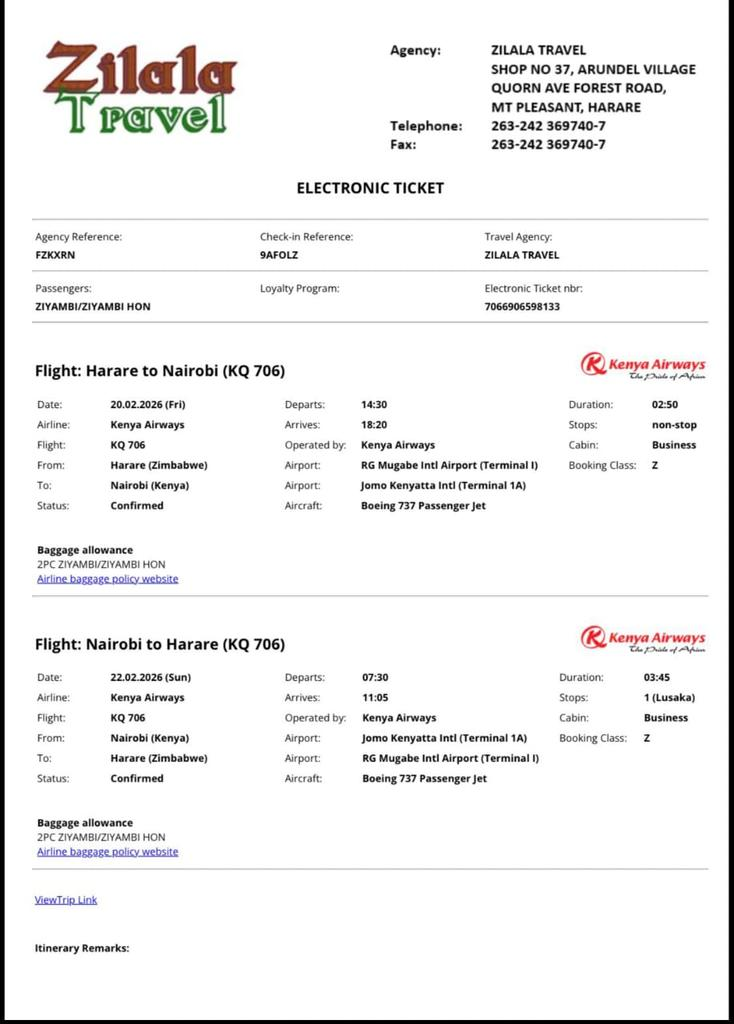
Zimbabwe’s constitutional crisis has taken an even darker turn with the revelation that Justice Minister Ziyambi Ziyambi travelled to Nairobi to consult Jonathan Moyo on proposed amendments designed to entrench President Emmerson Mnangagwa in power until 2030. This was not a routine diplomatic visit. It was a calculated political manoeuvre aimed at bending the supreme law to suit one man’s ambition. Zimbabweans are being asked to believe that these amendments are about reform when the facts point clearly to consolidation of power and the erosion of democratic choice.
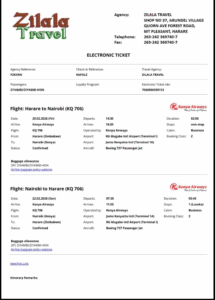
Ziyambi cut short plans to attend the United Nations Human Rights Council meeting in Geneva, choosing instead to prioritise the ninety day public debate on constitutional changes that have already been gazetted. His itinerary shows a hurried dash from Harare to Nairobi aboard a Kenyan Airways aircraft, followed by a delayed return. The destination mattered less than the purpose. Jonathan Moyo is part of a team of consultants hired to advise government on amendments that extend presidential terms, redraw electoral processes, and remove the people from choosing their own leader through direct vote.
This alone should alarm every citizen. A constitution is not a private contract between politicians and consultants. It is a social covenant between the state and its people. Yet ZANU PF treats it as a flexible document to be rewritten whenever power feels threatened. Mnangagwa’s two term limit expires in 2028, but rather than prepare for succession, the regime wants to extend presidential tenure, stretch terms from five to seven years, and abolish direct presidential elections altogether. This is not reform. It is regression dressed up as legal sophistication.
While Ziyambi busied himself with these consultations, Zimbabwe forfeited a critical presence at the sixty first session of the United Nations Human Rights Council, which runs from twenty three February to thirty one March. The country will now be represented by Attorney General Virginia Mabiza, appointed in November 2023 and the first woman to hold that office. This summit will be a baptism of fire for her, as Zimbabwe’s atrocious human rights record faces intense scrutiny from civil society groups and international critics.
The timing could not be worse. The Council will debate protection of human rights defenders, freedom of religion, rights to food and housing, and human rights in the context of countering terrorism. It will also examine grave abuses in countries such as Afghanistan, China, Syria, Iran, North Korea, and the Occupied Palestinian Territory and Israel. This session occurs at a moment when the global human rights system is under severe strain, weakened by selective application of international law, ongoing wars, and deepening mistrust of multilateral institutions.
Zimbabwe’s own record has repeatedly been exposed in Geneva, where glossy government statements clash sharply with testimonies from victims and activists. Only days ago, journalist Blessed Mhlanga told the summit that local media is reeling from political repression and lawfare. That reality cannot be hidden by changing constitutional clauses at home.
ZANU PF wants the world to look away while it quietly dismantles the last safeguards of democracy. Extending term limits, silencing voters, and outsourcing constitutional engineering to politically compromised figures is an insult to every Zimbabwean who voted for change. A nation that fears the ballot has already lost its moral authority. History will judge this moment harshly, and no amendment will rewrite that verdict.